
Frequently Asked Questions
Frequently Asked Questions
Frequently Asked Questions
Frequently Asked Questions
Frequently Asked Questions
Disclaimer
The information in the FAQs below is based on the observations and experience of the team at Seedling Foundation to provide information to the general public for their understanding. The content is simplified for ease of reading and does not constitute legal advice or an official interpretation of the law.
Policies, procedures, and practices may vary across locations and may change over time. For case-specific guidance or legal clarity, readers are advised to consult official government notifications, legal professionals, or concerned authorities.
The information shared here is intended to promote awareness, sensitivity, and informed engagement around child rights and juvenile justice, while respecting the confidentiality and dignity of children involved.
FAQs
What is an Observation Home (Nirikshan Grah)?
An Observation Home (Nirikshan Grah) is a government-run facility where children who have allegedly committed an offence are housed temporarily. These children are called Children in Conflict with Law (CCL).
People often understand Observation Homes through older or incorrect terms such as Juvenile Home, Remand Home, Sudhar Grah, or “Bachchon ka Jail”. These terms are no longer used. The correct legal term is Observation Home (Nirikshan Grah).
How is it different from a jail?
An Observation Home focuses on care, protection, and reform of children. Jails are meant for punishment of adults. Children are not locked up like prisoners, and are provided education, counselling, and care. The overall environment is child-friendly, the rules are less strict than a prison, and facilities are better suited to children’s needs.
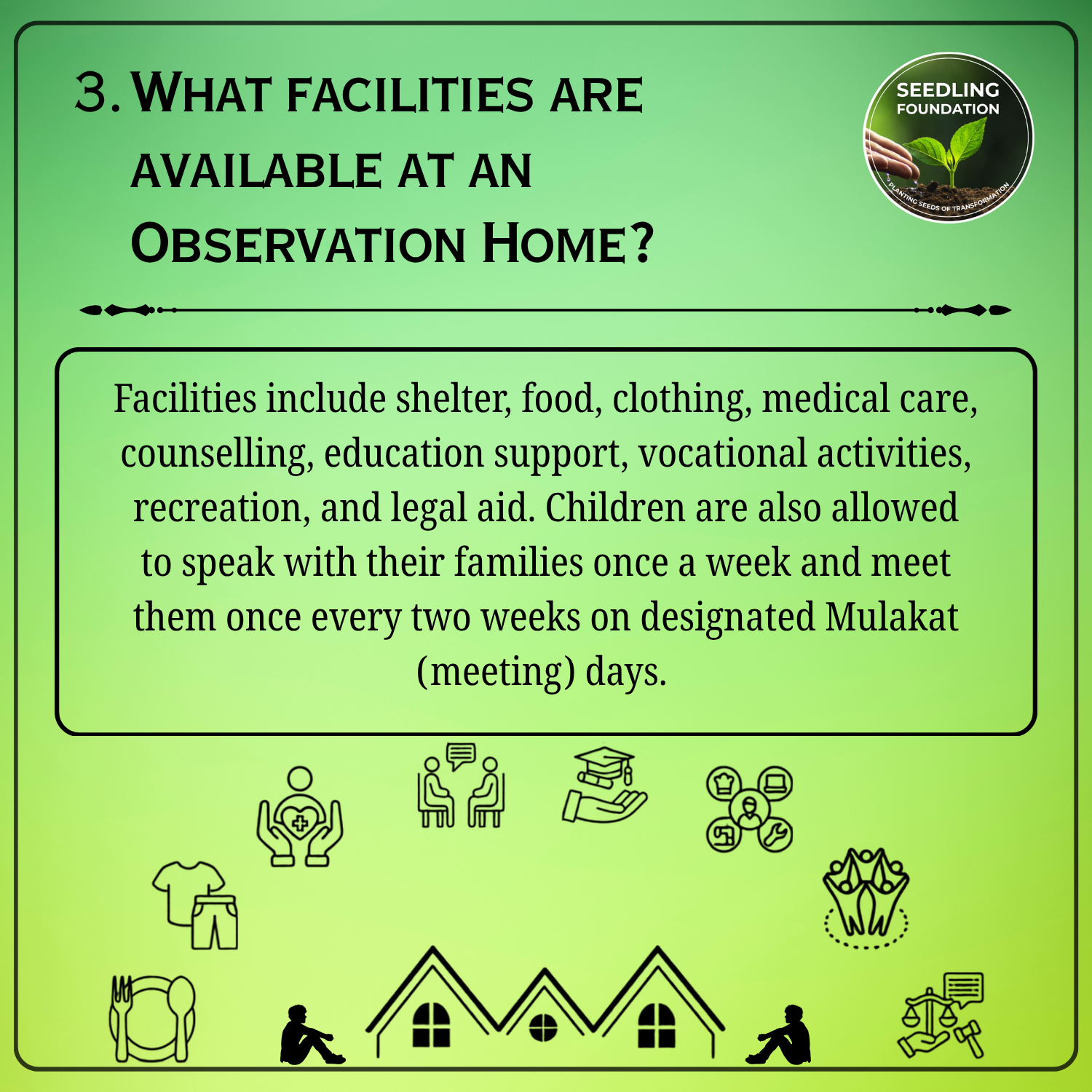
What facilities are available at an Observation Home?
Facilities include shelter, food, clothing, medical care, counselling, education support, vocational activities, recreation, and legal aid. Children are also allowed to speak with their families once a week and meet them once every two weeks on designated Mulakat (meeting) days.
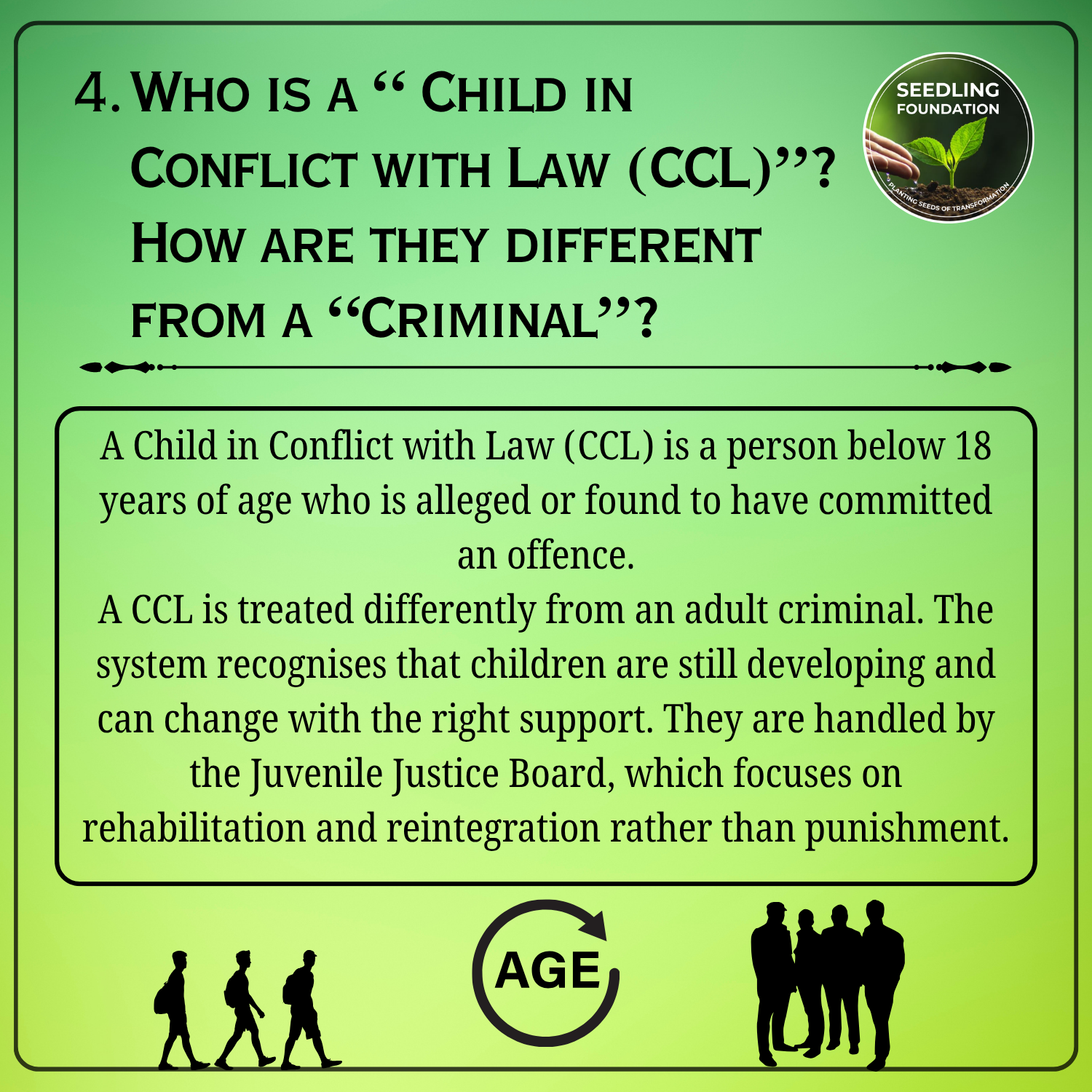
Who is a “ Child in Conflict with Law (CCL)”? How are they different from a “Criminal”?
A Child in Conflict with Law (CCL) is a person below 18 years of age who is alleged or found to have committed an offence.
A CCL is treated differently from an adult criminal. The system recognises that children are still developing and can change with the right support. They are handled by the Juvenile Justice Board, which focuses on rehabilitation and reintegration rather than punishment.
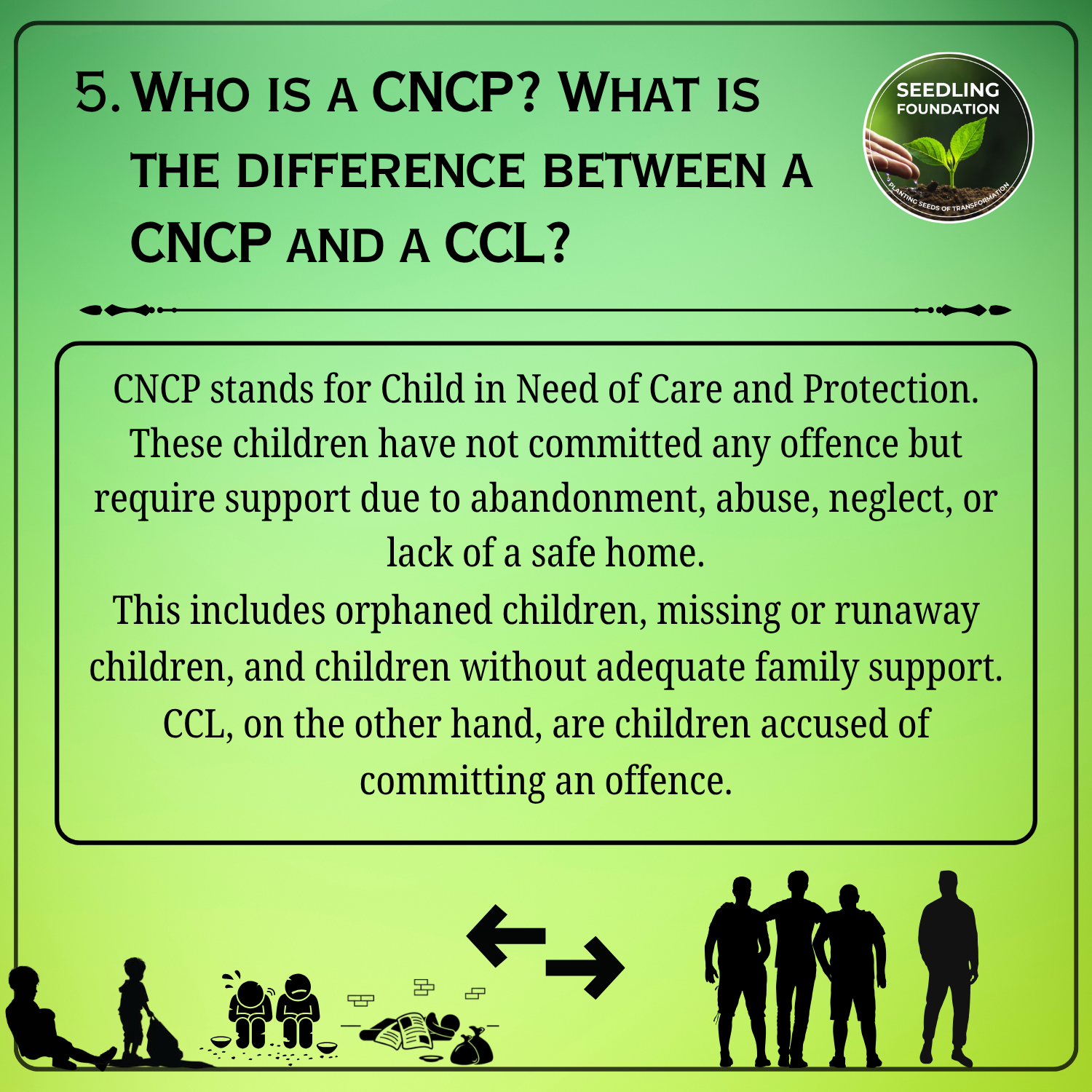
Who is a CNCP? What is the difference between a CNCP and a CCL?
CNCP stands for Child in Need of Care and Protection. These children have not committed any offence but require support due to abandonment, abuse, neglect, or lack of a safe home.
This includes orphaned children, missing or runaway children, and children without adequate family support. CCL, on the other hand, are children accused of committing an offence.
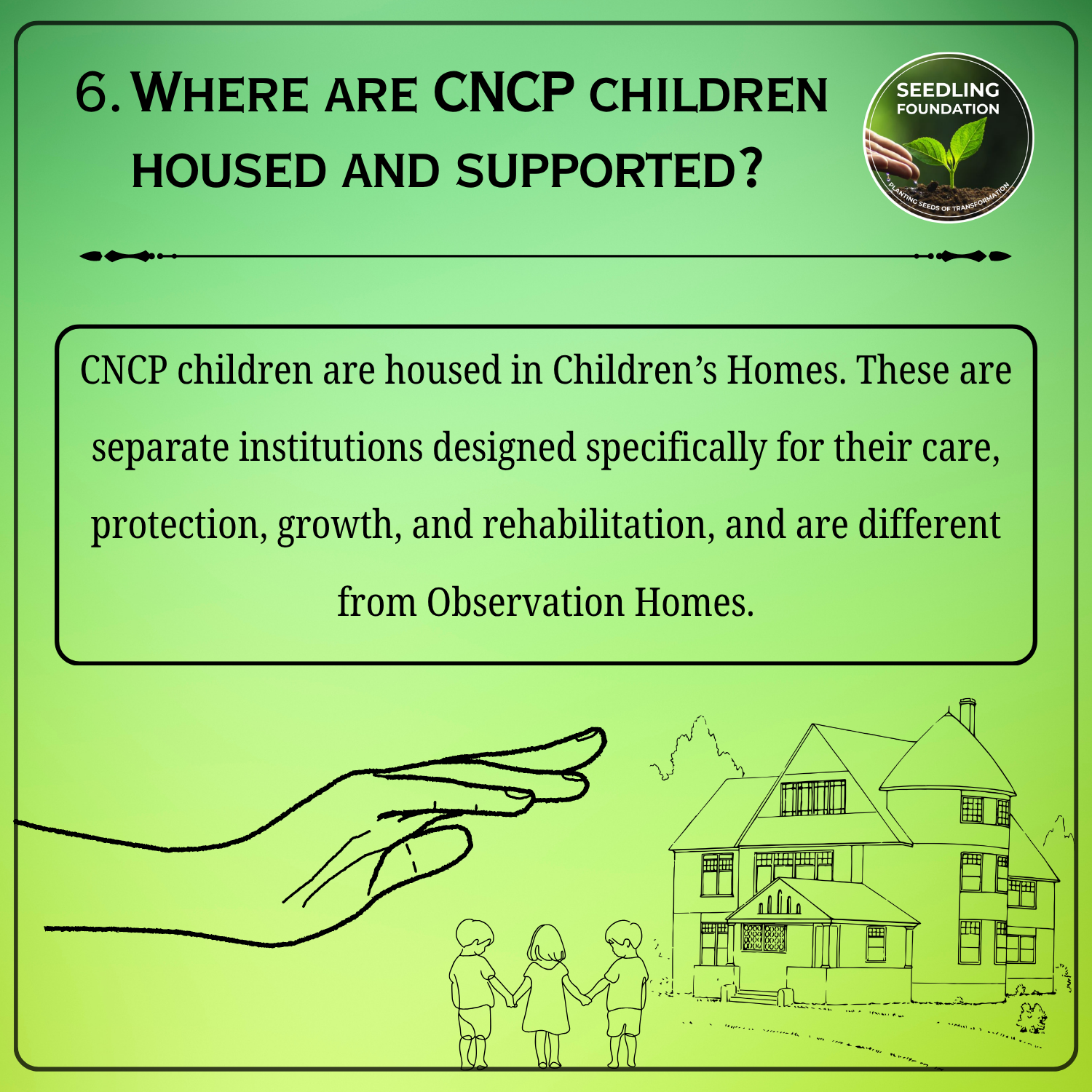
Where are CNCP children housed and supported?
CNCP children are housed in Children’s Homes. These are separate institutions designed specifically for their care, protection, growth, and rehabilitation, and are different from Observation Homes.
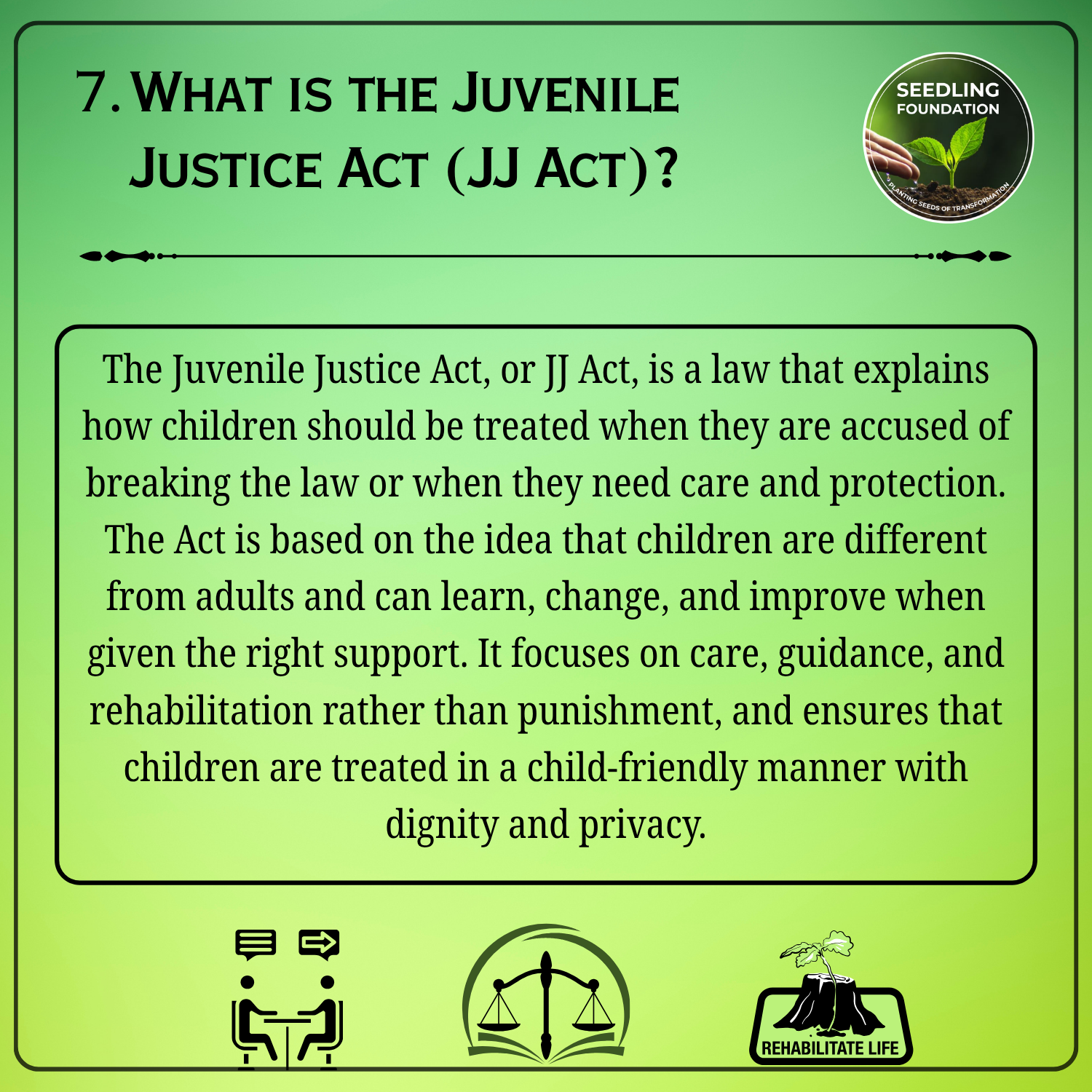
What is the Juvenile Justice Act (JJ Act)?
The Juvenile Justice Act, or JJ Act, is a law that explains how children should be treated when they are accused of breaking the law or when they need care and protection.
The Act is based on the idea that children are different from adults and can learn, change, and improve when given the right support. It focuses on care, guidance, and rehabilitation rather than punishment, and ensures that children are treated in a child-friendly manner with dignity and privacy.
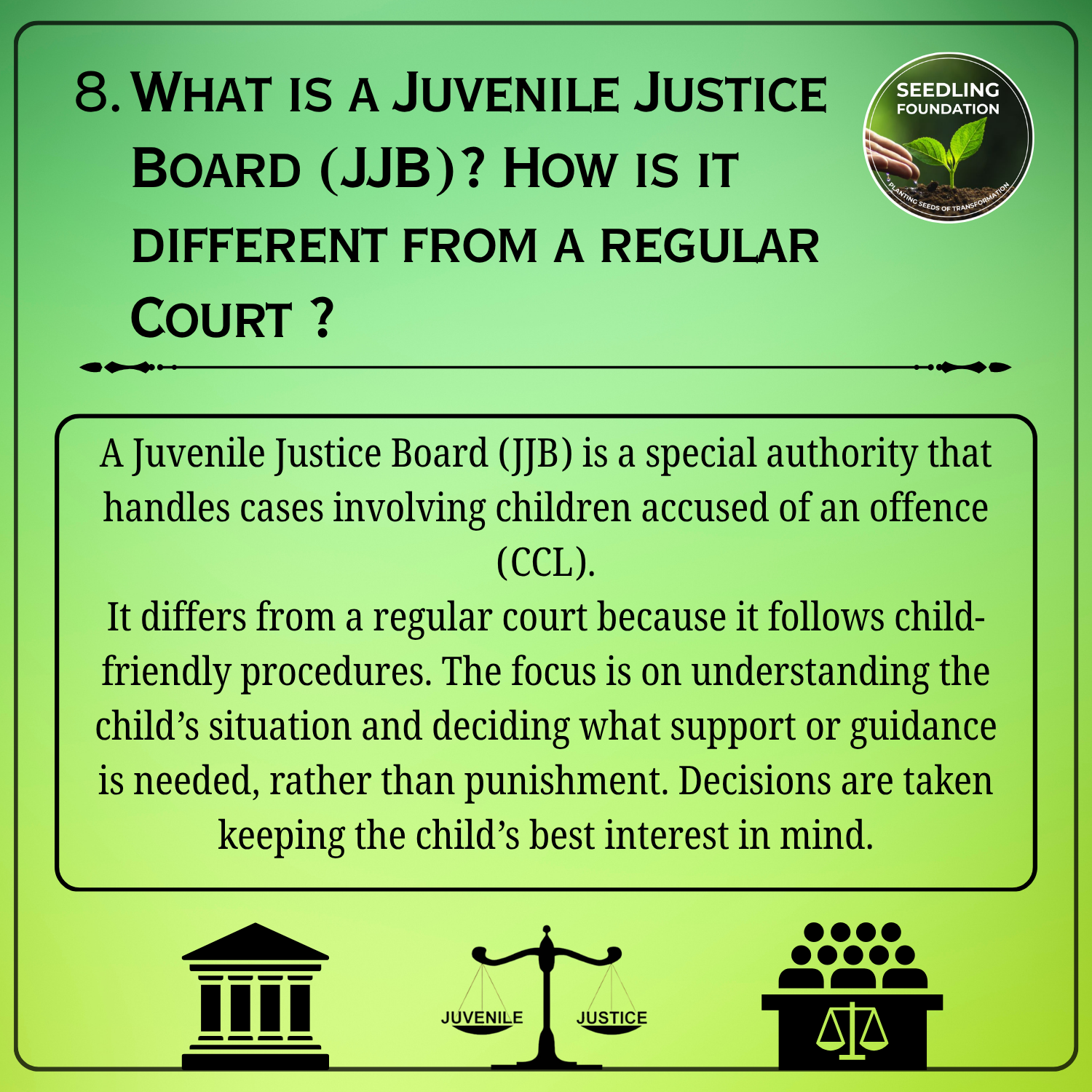
What is a Juvenile Justice Board (JJB)? How is it different from a regular Court?
A Juvenile Justice Board (JJB) is a special authority that handles cases involving children accused of an offence (CCL).
It differs from a regular court because it follows child-friendly procedures. The focus is on understanding the child’s situation and deciding what support or guidance is needed, rather than punishment. Decisions are taken keeping the child’s best interest in mind.
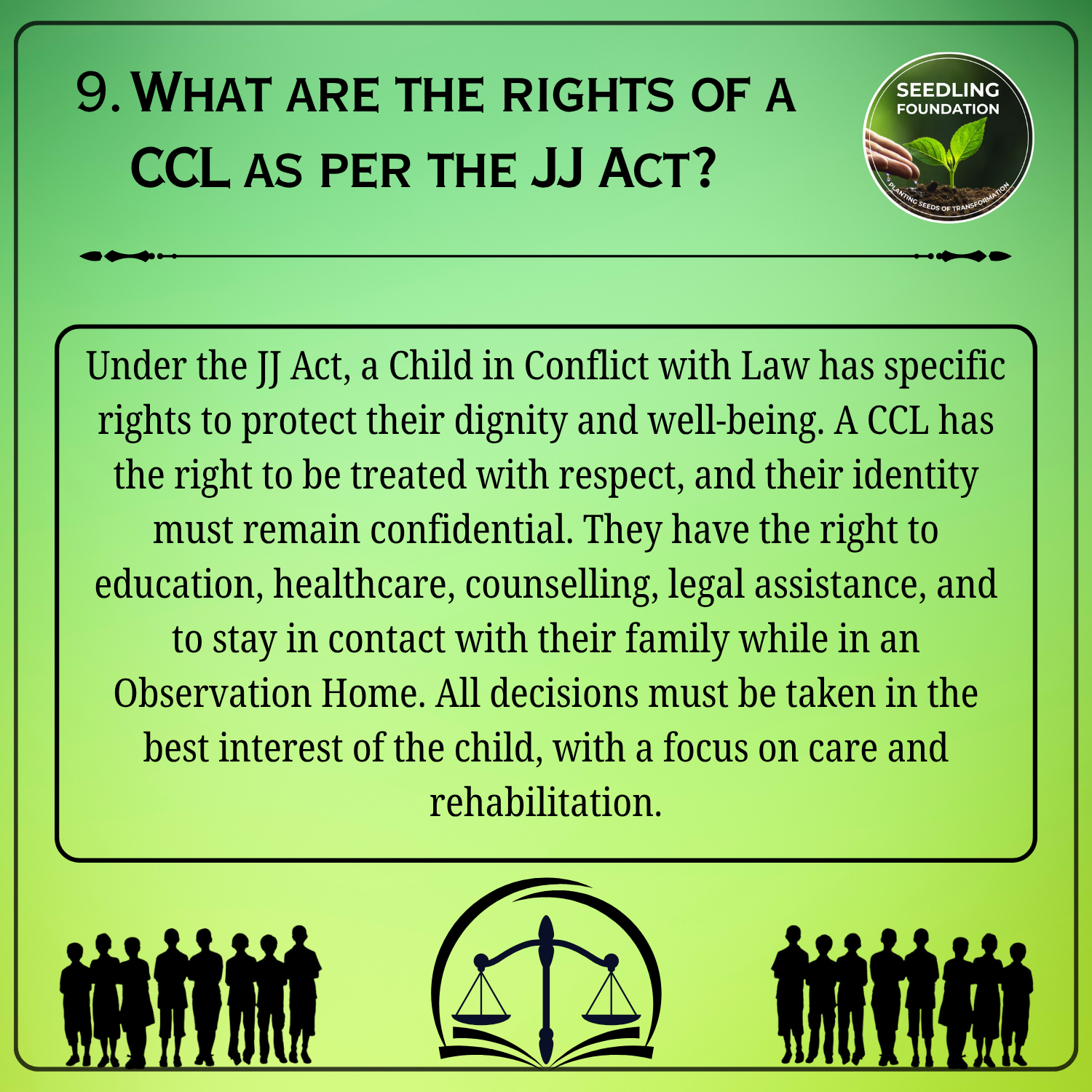
What are the rights of a CCL as per the JJ Act?
Under the JJ Act, a Child in Conflict with Law has specific rights to protect their dignity and well-being. A CCL has the right to be treated with respect, and their identity must remain confidential. They have the right to education, healthcare, counselling, legal assistance, and to stay in contact with their family while in an Observation Home. All decisions must be taken in the best interest of the child, with a focus on care and rehabilitation.
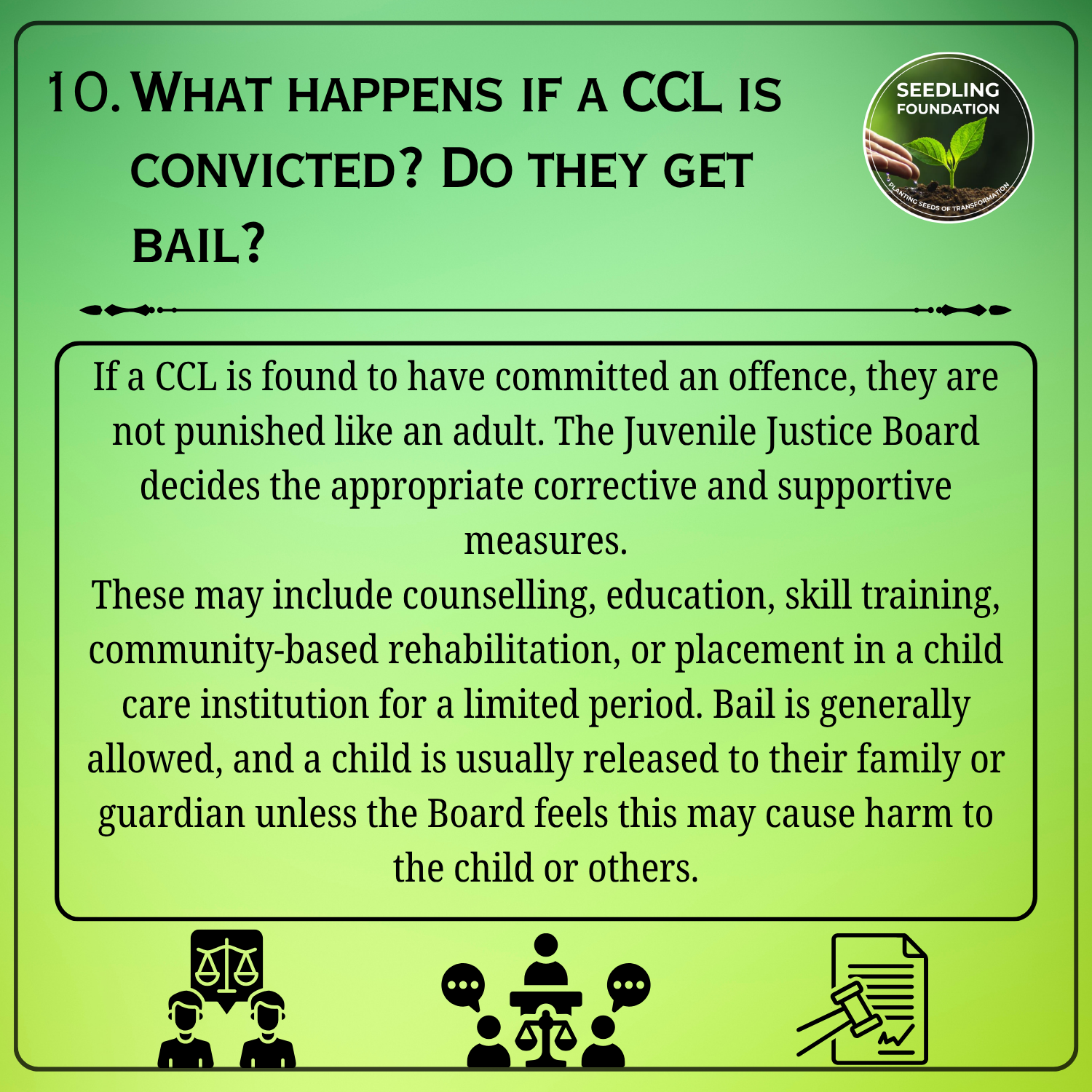
What happens if a CCL is convicted? Do they get bail?
If a CCL is found to have committed an offence, they are not punished like an adult. The Juvenile Justice Board decides the appropriate corrective and supportive measures.
These may include counselling, education, skill training, community-based rehabilitation, or placement in a child care institution for a limited period. Bail is generally allowed, and a child is usually released to their family or guardian unless the Board feels this may cause harm to the child or others.
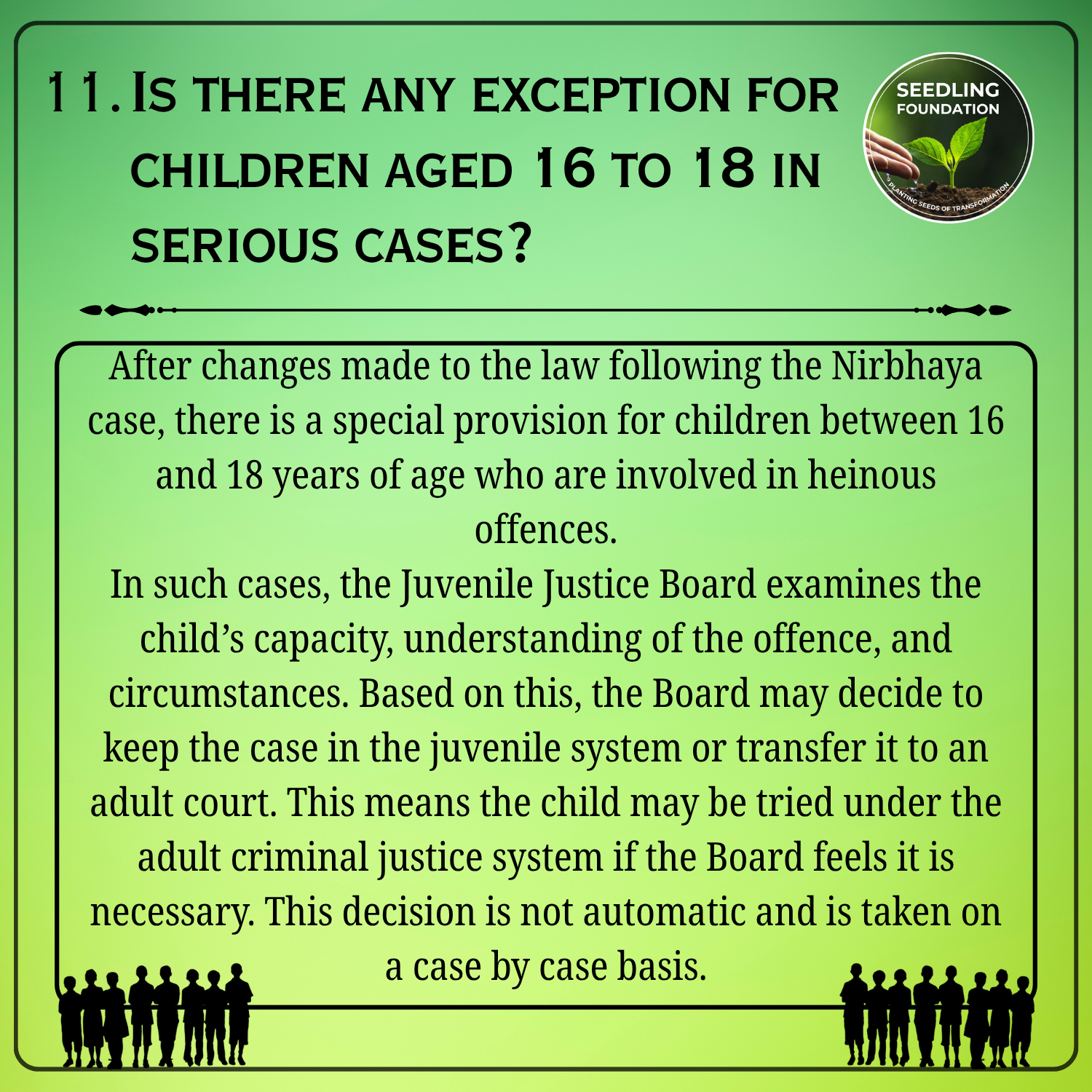
Is there any exception for children aged 16 to 18 in serious cases?
After changes made to the law following the Nirbhaya case, there is a special provision for children between 16 and 18 years of age who are involved in heinous offences.
In such cases, the Juvenile Justice Board examines the child’s capacity, understanding of the offence, and circumstances. Based on this, the Board may decide to keep the case in the juvenile system or transfer it to an adult court. This means the child may be tried under the adult criminal justice system if the Board feels it is necessary. This decision is not automatic and is taken on a case by case basis.
What happens once a child turns 18 years old?
Turning 18 does not automatically change how a case is handled. If the offence was committed when the person was below 18, the case usually continues under the juvenile justice system. Decisions continue to be taken by the Juvenile Justice Board based on the child’s age at the time of the offence.
What kind of cases are seen at the Dongri Observation Home?
Dongri Observation Home sees a wide range of cases involving children. These include petty offences such as theft and chain snatching, as well as serious and heinous offences such as sexual assault, attempted murder, and murder.
What is the average duration of stay at the Home?
The duration of stay depends on the nature of the case and the judicial process. For smaller offences, the stay may be around one month. For more heinous offences, it can extend up to three years. On average, most children stay for about four to eight months.
Are there only CCL boys at the Dongri Observation Home?
Dongri Observation Home has separate sections for boys and girls. The boys’ section houses only CCL. In the girls’ section, both CCL girls and CNCP girls stay together. At any given time, there are usually only a few CCL girls, and most girls staying at the Home are CNCP.
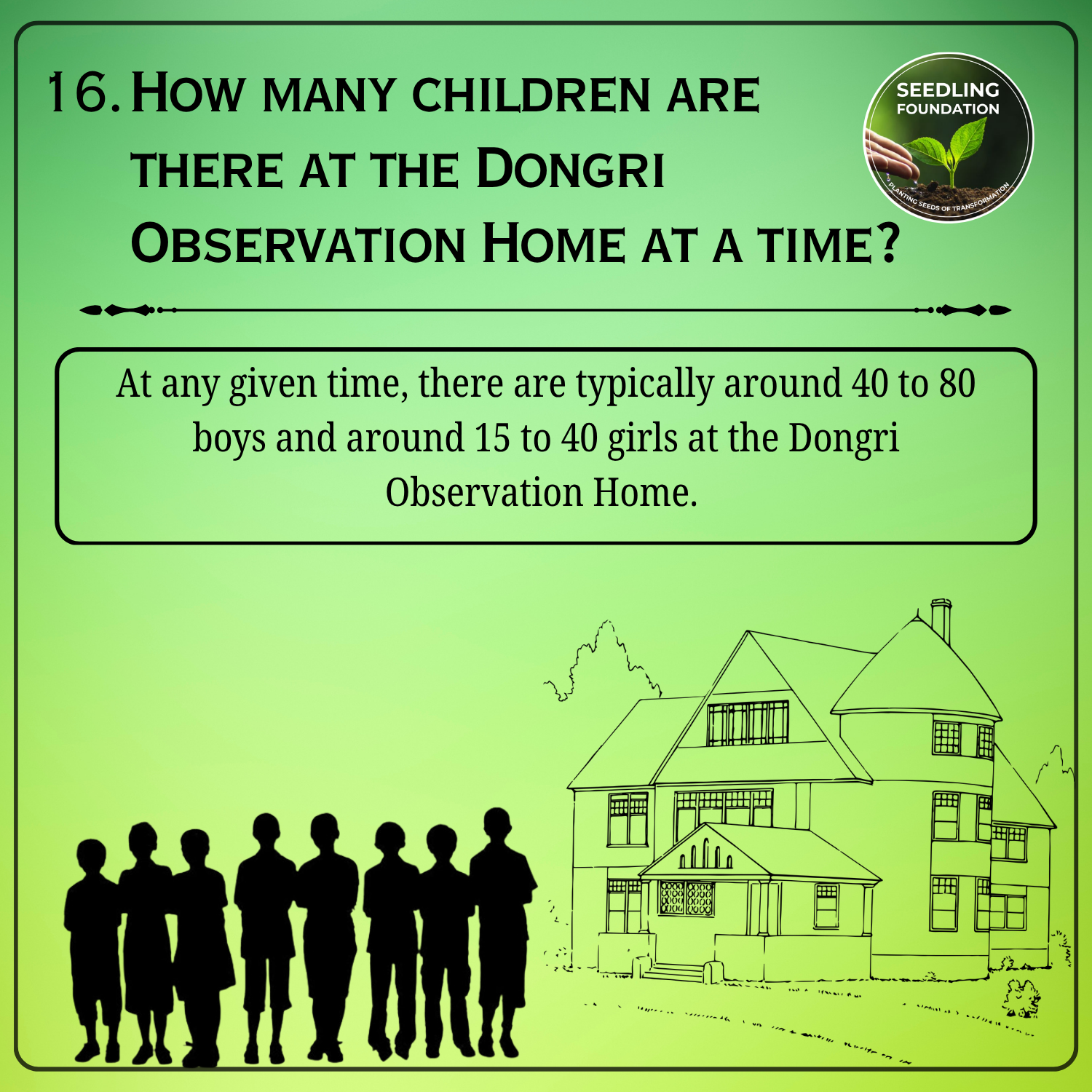
How many children are there at the Dongri Observation Home at a time?
At any given time, there are typically around 40 to 80 boys and around 15 to 40 girls at the Dongri Observation Home.
What is the background of children coming to the Dongri Observation Home?
Many children come from economically weaker families. A large number have dropped out of school or have irregular schooling. Family situations often include broken families, domestic violence, addiction, or lack of adult support. Some children also face substance use issues and negative peer influence, which affect their behaviour and choices.
Is it safe for staff and NGOs to work at the Observation Home?
Children at the Dongri Observation Home are generally respectful towards staff and NGO members. From a safety point of view, it is safe to work at the Home. Occasionally, fights may occur among children, but it is very rare for any staff member to be harmed. Female staff and NGO members can also work safely at the Dongri Observation Home.
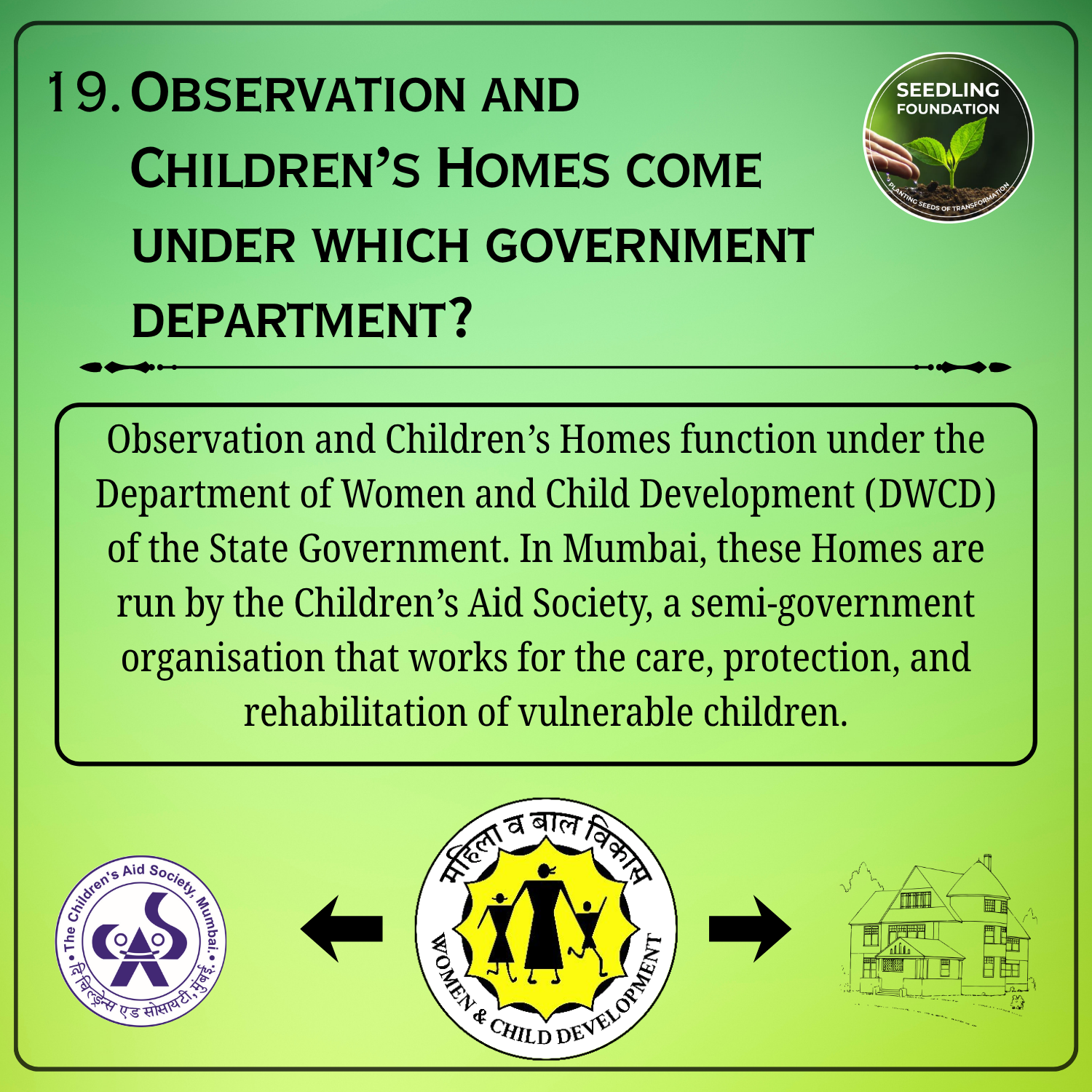
Observation and Children’s Homes come under which government department?
Observation and Children’s Homes function under the Department of Women and Child Development (DWCD) of the State Government. In Mumbai, these Homes are run by the Children’s Aid Society, a semi-government organisation that works for the care, protection, and rehabilitation of vulnerable children.
What is Children’s Aid Society (CAS)?
Children’s Aid Society (CAS) is a semi-government organisation that runs Observation Homes and Children’s Homes in Mumbai. There are eight Homes under CAS, including the Dongri Observation Home. These include Matunga David Sassoon Industrial Home, Chembur Children’s Home, Bal Kalyan Nagari, Additional and New Children’s Home, MDC Home, and an ITI institute.
How many Observation Homes are there in Mumbai?
Mumbai has one Observation Home at Dongri. Another Observation Home is located at Bhiwandi, which caters to Thane district.
How can society get involved and contribute?
Children at Observation Homes need support from society to rebuild their lives and find positive direction. Community involvement plays an important role in this process.
Individuals and organisations can contribute in practical ways such as volunteering time, teaching life skills, providing education support, counselling, or vocational training. Donations of resources and funds help improve facilities and programs.
Employers can support rehabilitation by offering internships or job opportunities to children who are ready. Even spreading awareness, reducing stigma, and speaking with empathy about these children helps create a more supportive environment for their reintegration into society.
FAQ Images
Here are the same FAQs as images. Feel free to use them by saving or sharing as needed. You can open the images and right click on them to “Save” or “Copy” them.
Closing Note
If you have a question that is not covered here, we invite you to share it with us. These FAQs are meant to grow based on what people want to understand and discuss.
The juvenile justice system works best when society stays informed, involved, and compassionate. Participation through awareness, support, and inclusion plays an important role in helping children find a better path forward.